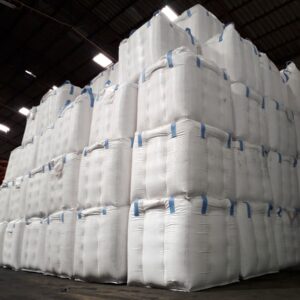
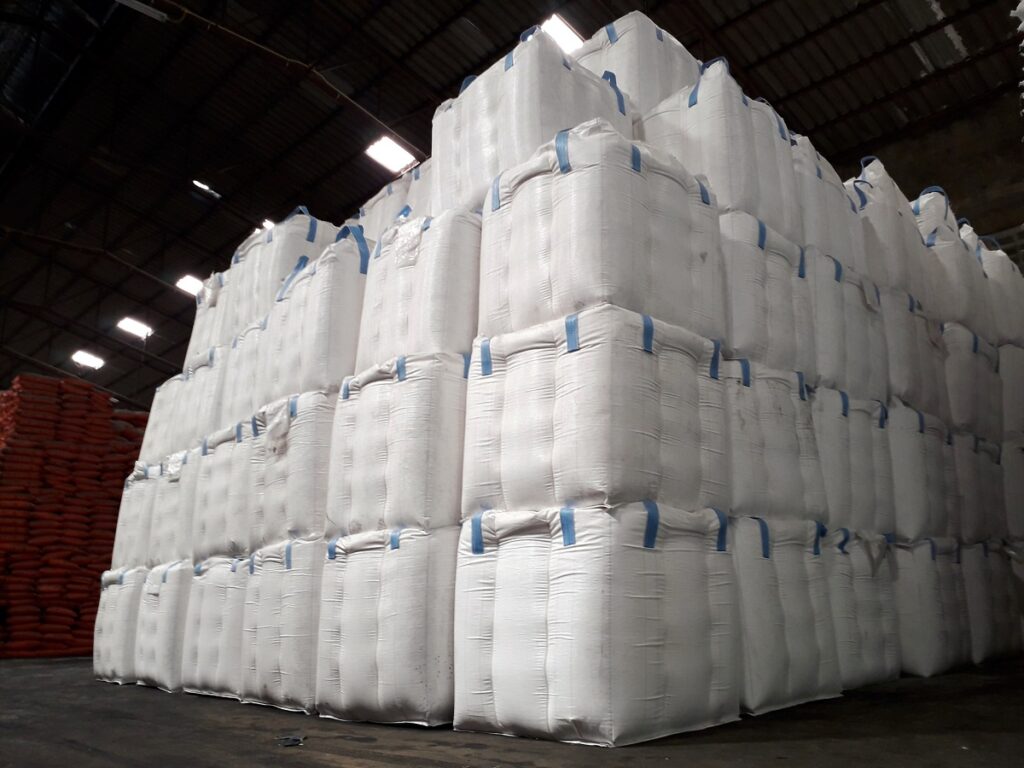
Flexible Intermediate Bulk Containers (FIBC), commonly known as bulk bags, are widely used for transporting and storing dry, flowable materials across industries such as chemicals, minerals, agriculture, and construction. Typical safe working loads range from 500 kg to over 2000 kg, and the structural integrity of each bag is critical to operational safety.
Unlike smaller packaging formats, FIBC performance is not evaluated one unit at a time. Most users rely on batch-based quality control, meaning that consistency across production lots becomes far more important than isolated test results. In this context, even minor variations in material or process control can become amplified under high loads and real-world handling conditions.
Quality variation in FIBC rarely stems from a single defect. More often, it results from small deviations accumulating across multiple stages of production.
Raw Material Variability
At first glance, polypropylene (PP) used in FIBC production may appear standardized. However, several material-level factors can influence final bag performance:
- Melt Flow Index (MFI) variation between resin batches: Even when sourced under the same grade, small differences in flow behavior can affect tape formation and tensile properties.
- Additive consistency: Anti-UV stabilizers, anti-oxidants, and processing aids must be uniformly dispersed. Minor deviations can influence long-term performance, especially under outdoor exposure.
- Calcium carbonate filler control: Filler ratios impact stiffness, weight, and elongation behavior. Variability in mixing can create uneven mechanical performance.
- Recycled material integration (where applicable): If used, recycled content must be strictly controlled to avoid unpredictable mechanical response.
Importantly, the same material grade does not automatically guarantee identical performance. What matters is how consistently the material behaves in the production environment.
Tape Extrusion and Weaving Stability
The tape (flat yarn) production stage is one of the most critical control points in FIBC manufacturing.
During extrusion and stretching, several parameters influence tape strength and uniformity:
- Temperature stability across extrusion zones
- Stretching ratio consistency
- Cooling rate control
- Tape thickness uniformity
Small fluctuations in stretching ratios can alter molecular orientation, directly impacting tensile strength.
In the weaving stage, additional variables come into play:
- Warp and weft tension balance
- Loom speed consistency
- Fabric density control
- Edge reinforcement alignment
Fabric uniformity is essential because FIBC strength depends on distributed load transfer. Uneven tension or density variations can create localized weak zones that only reveal themselves under load.
Cutting, Sewing, and Structural Design
Many field failures attributed to “fabric weakness” are in fact related to structural assembly.
Key factors include:
- Sewing thread strength and compatibility
- Stitch density and seam type
- Seam alignment and overlap consistency
- Lift loop attachment method and load path design
FIBC bags are structural systems. The way lift loops transfer force into the body fabric significantly influences overall safety performance. Poor alignment or inconsistent reinforcement can create stress concentration points.
Environmental and Storage Influences
Quality consistency does not end at production.
FIBC performance can be affected by:
- Prolonged UV exposure before use
- High humidity storage conditions
- Compression during stacking
- Transport vibration and handling stress
In some cases, what appears to be a manufacturing defect is actually the result of environmental interaction with marginally controlled production parameters.
Understanding the interaction between manufacturing tolerance and real-world conditions is essential.
Why Single Test Results Are Not Enough
FIBC quality is often evaluated through periodic tensile and load tests. While these are necessary, they do not fully capture production stability.
A bag can pass a standard test while still exhibiting higher-than-normal variability within a production batch.
True consistency depends on:
- Locked process parameters
- Documented batch records
- Fabric weight monitoring
- Regular mechanical sampling
- Structural verification during assembly
Stability is not achieved by inspection alone, but by repeatable process control.
Conclusion
Quality variation in FIBC does not originate from a single source. It is typically the result of incremental deviations across materials, extrusion, weaving, structural assembly, and environmental exposure.
Consistent performance requires coordinated control across all stages of production.
FIBC stability is therefore not defined by one strength value, but by the discipline of process management behind it.