In the global bulk packaging industry, FIBC (Flexible Intermediate Bulk Containers) are often evaluated based on specifications — fabric weight, coating, safety factor, and design drawings.
However, in real production environments, two FIBC orders with identical specifications can perform very differently.
This is not an exception. It is a structural reality shaped by both manufacturing processes and application complexity.
1. Material Consistency Is Only the Starting Point
Many buyers focus on polypropylene (PP) raw materials, assuming stable input leads to stable output.
In practice, material consistency is only one variable.
Variations in:
- extrusion temperature control
- tape stretching ratios
- weaving tension
can significantly affect final fabric performance — even when the raw material grade remains unchanged.
2. Semi-Standardized Production Chains
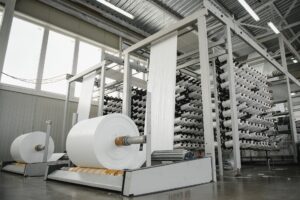
Unlike highly automated industries, FIBC production typically involves multiple semi-independent processes:
- extrusion
- weaving
- cutting
- sewing
- printing
These processes may be handled across different workshops or even separate facilities.
Each step introduces variability. Without strong integration, consistency is difficult to achieve.
3. Application Understanding Drives Design Outcomes
FIBCs are not standardized consumer products. They are application-driven industrial solutions.
If the real usage conditions are not clearly understood during the design phase, even well-produced bags may underperform.
Key factors include:
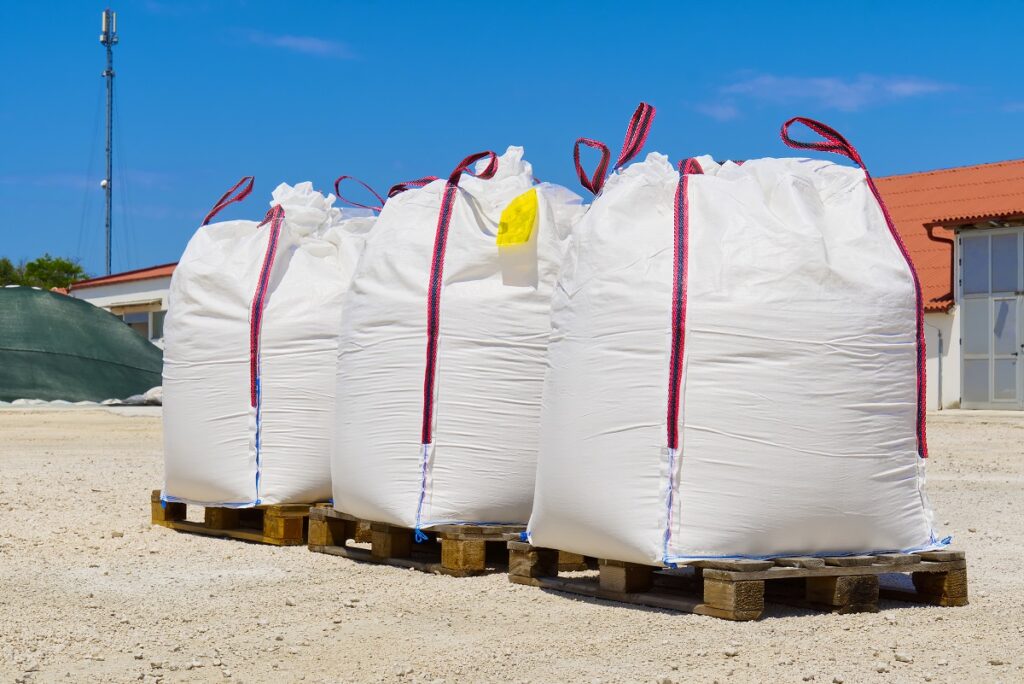
- storage environment (indoor vs. outdoor, UV exposure)
- storage duration
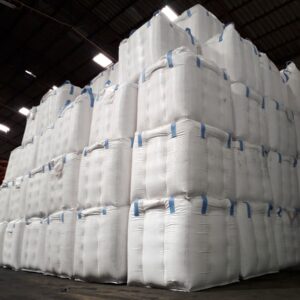
- stacking height and load conditions
- handling methods (manual vs. forklift vs. automated systems)
For example:
- higher stacking requires better creep resistance
- long-term outdoor storage demands stronger UV stabilization
- automated handling requires tighter dimensional consistency
Design decisions must reflect these realities.
4. Operator Experience Still Matters
Even with defined specifications, certain production steps rely heavily on operator judgment:
- sewing tension
- liner alignment
- reinforcement positioning
These are not fully standardized processes.
Operator skill differences can lead to subtle but meaningful variations.
5. Interpreting Test Data Requires Experience
Quality evaluation is not only about testing — it is about understanding test data.
Common tests include:
- tape strength and elongation
- fabric tensile performance
- full bag safety factor tests
However, the key difference lies in:
whether data is simply checked for compliance
or deeply analyzed for trends and process feedback
For example:
small variations in tape elongation can amplify under load;
fabric stability differences can impact long-term stacking behavior.
Experience determines whether test data is truly utilized.
6. Quality Control Is Often Reactive
Many factories rely on final inspection rather than process control.
This approach detects defects but does not eliminate root causes.
True consistency requires:
- in-process monitoring
- standardized procedures
- feedback loops across production stages
7. Learning from Past Issues Builds Systems
Quality issues are inevitable in manufacturing.
What differentiates suppliers is how they respond:
- Is there a traceability system?
- Are issues analyzed across processes?
- Are improvements standardized and reused?
Without systematic learning, the same problems tend to repeat.
8. Consistency Is a System, Not a Specification
Consistency is not defined by a single parameter.
It is the result of:
- material stability
- process control
- application understanding
- data interpretation
- production integration
- operator experience
- continuous improvement systems
Without alignment across these elements, variation is unavoidable.
Conclusion
FIBC quality variation is not just a supplier issue — it is an industry-wide structural challenge.
For buyers, evaluating a supplier requires going beyond specifications and pricing, and understanding:
- how production is organized
- how processes are controlled
- how knowledge is accumulated
This is where long-term reliability is determined.